Beyond Pessimism
On finding freedom while sailing into the unknown

“A little truth is a truth in which the opposite is false. A great truth is a truth in which the opposite is also true.” – Niels Bohr
“The greater the contrast, the greater the potential. Great energy only comes from a correspondingly great tension of opposites.” – Carl Jung
Not knowing is hard. At times, it is outright terrifying. We associate knowing with safety—if I know how the people and the world around me work, I can relax and trust that I and those I love will be okay. My years of wrestling with long Covid were a brutal spiral of unknowing. Nobody could tell me what was happening to my body or when and how it might end, keeping me in a state of constant threat, a tense alertness that exacerbated my symptoms.
There is a satisfying sense of control we get when knowing. That underpins the peculiar and pernicious human trait that we would rather know that something will have a terrible outcome than remain in uncertainty. We all do it at times. Believing we know a negative outcome is inevitable protects us from the hurt of disappointment and provides our ego with relational power. If I know a situation is or will be bad, I can identify as a victim and solicit care from myself and others.
This has been vividly described as “running a racket.” On the surface, there is a legitimate—even noble—establishment, perhaps a toy shop or a shelter for lost puppies, inviting our engagement, sympathy, and respect. But walk down the dark stairs and there is a smoke-filled basement with an old man counting his laundered drug money. Our ego, cigar clenched in teeth, runs the show and our righteous certainty is his front. Joe Hudson calls this “topping from the bottom,” and once we pay attention, we start noticing it everywhere in ourselves, our relationships, our organizations, and our politics.
The capacity to see the world as paradox and ambiguity is an invitation into unknowingness. Many people find this threatening. It challenges the psychic structures we all spend the first part of life building. We feel it is encouraging us to tolerate or even embrace ideas and beliefs and people we find distasteful, dissolving our hard-won identity and moral framework into a formless, passive goo.
But like most stories our fears tell us, that threat is hollow. When properly cultivated, the capacity for paradox makes us more fully and freely ourselves. It does so partly by liberating us from our own rackets. Consider two examples from our rapidly evolving world.
Beyond the Map
Most of us are watching the development of generative AI with astonishment and fear. I, like many, have been saying that we must brace ourselves for the job losses that will be inevitable and devastating. But maybe they aren’t. Ezra Klein reminds us of Jevons’ Paradox which has defined past technological transitions—major improvements in efficiency lead to more demand for an asset rather than less. The introduction of the spreadsheet spawned more accountants rather than eliminating them.
My chain-smoking ego claims that AI-driven job losses are inevitable so it can grimly prepare for disaster (and coax some maternal comfort from other parts of my mind). Jevons’ Paradox drags it out into the street where it sits exposed and blinded by the sun.
The 2024 US election was a disaster for beleaguered Ukraine and those who oppose Putin’s ambitions. Many pundits agreed that the US withholding support for the far smaller country and undermining NATO and its European allies would eliminate any hope Ukraine had of reclaiming its lost territory. In the down is down logical view of the world, fewer resources equal eventual military failure. Except in this case, as Andrew Sullivan notes, it hasn’t. Ukraine’s lack of traditional military hardware has spurred it to lead a global revolution in drone warfare, and America’s abandonment and threats have caused Europe to dramatically increase its support. At the moment, despite all its advantages, Russia is on the back foot. Down has, in some ways, been up for Ukraine.
Klein and Sullivan remind us to relax our knowing, to surrender that satisfying little hit of control we get from reading the news every day and being certain AI will fuel unemployment and Ukraine will lose. Yet both authors could be in danger of falling into the opposite trap—we suffer just as much from certainty of positive outcomes. Their writing mostly presents a mature uncertainty, with Sullivan, for example, regretting his past pessimism while also recognizing this seemingly positive development could lead to an awful escalation like Russia invading the Baltics.
These authors presenting strong perspectives amid great uncertainty addresses one of the most common misconceptions about the middle way of holding paradox—that it fosters passivity. In the middle way, everything belongs, everything has its role. Jingoistic brutes unwittingly empower overwhelmed underdogs, and new intelligence may unleash humans as it replaces them. But that does not mean we just sit and passively watch the storm. We dance within it.
Klein and Sullivan can hold strong opinions about and potentially help shape unfolding events while (hopefully) recognizing that they know no more about what will happen next than anyone else. Strong leaders can hold the many contradictions within their organizations—enough and not enough; urgent and patient—while still taking decisive action.
Monk or Captain
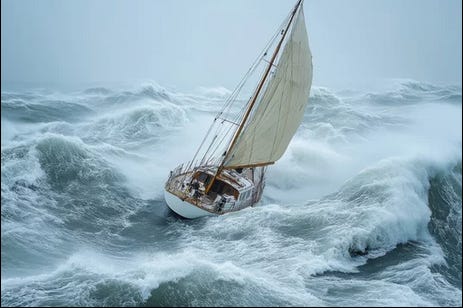
The quality or virtue commonly associated with the middle way is equanimity, a calm witnessing of the many storms of life. This is vital but alone can indeed lead to passivity. It needs to be married with equipoise, a dynamic balancing of weight and force, as I argue in the book I am (slowly) writing. Think of a sailboat tacking into a strong wind, the opposition between wind and water the source of its speed in the hands of a skilled captain. With equipoise, we can allow the tensions of life’s paradoxes to propel us forward, to generate new action and art in the world, without succumbing to the temptations of arrogance and pessimism and certainty.
Equipoise also conjures the image of a suspension bridge, the tension between the downward weight of its deck and the upward pull of its cables allowing it to hold immense weight. How many of us need more ways to gracefully carry the weights of our lives and the world?
And equipoise is a term of art in medical research that captures the moral stance of the middle way. To receive rigorous ethical approval, a trial must demonstrate “clinical equipoise,” genuine uncertainty about which treatment is superior. A great researcher holds that uncertainty while still hoping—and perhaps believing—that the new drug they are testing will surpass current practice and devoting themselves to the execution of the study. So it is with great leaders, policymakers, and citizens. They commit themselves to perspectives and actions while recognizing they do not know the outcomes and that there is truth and dignity in the opposing stance.
Unlike the clinical researcher, however, there is no fixed revelation of outcomes in most of leadership and life. To prevent us from avoiding hard truths or blaming others (that is, from settling back into our rackets), the rest of us must cultivate equipoise as a virtue rather than a structure, constantly seeking ways to challenge certainty in our opinions, actions, and even deepest beliefs.
Like Klein and Sullivan, I still find myself expressing strong opinions and fears about the world. But they now feel more like playacting, like I am watching myself argue and gesticulate to contribute to some dramatic scene while a deeper part of me smiles knowingly that I don’t know what I am talking about and what is going to happen. I love the thrum of the hull beneath my feet and the salt spray on my face. I feel, at times, that I am skillfully trimming the sails. But I have no idea where the bow is pointed; just where I hope and pray it might lead.
For much of my life, the idea of that deeper unknowing filled me with despair and dread. Now it is the source of immense joy and freedom. I don’t know, I cannot know, I don’t need to know. And yet the beautiful journey toward the setting sun continues.
May we all remember our unknowing, and may that unknowing rekindle our compassion for everyone navigating the winds of this brief life beside us.